


Strategic Planning Tips For Successful Acquisitions

31.3.2021

Australian M&A activity is on the rise, with $8 billion in transactions closed so far this calendar year, up 30% year-on-year.1 Both financial and strategic investors are taking advantage of cheap debt and strong economic tailwinds to identify value adding acquisitions.

Of course, identifying acquisitions and making them work are two very different things. A recent global M&A study concluded that 79% of companies who had recently completed an acquisition believed they successfully executed the acquisition, but only 35% believed they achieved operational success and sustained value creation.

How then should companies plan for a successful acquisition that delivers long-term value?

  • Setting defined outcomes and criteria

One of our mantras is that acquisitions should only be pursued if they accelerate a strategic objective of the company. Companies should have a defined growth plan, and understand how acquisitions can help to deliver this plan. This includes setting clear criteria for targets, understanding the objectives of both the buyer and seller, defining what “success” means for the acquisition, and regularly testing these assumptions as you proceed through the acquisition process.

  • Keep your core business a priority

Running an acquisition process is time consuming and distracting. A clear plan is required to understand who is responsible for each activity, and making sure that the process doesn’t negatively impact the core business.

  • Due Diligence

Effective planning allows for the acquiring business to thoroughly complete due diligence on the target, identifying and assessing areas of potential risk. All dimensions of the transaction should be addressed including validation of key commercial assumptions as well as financial, legal, tax, and other transaction specific items.

  • Maintain confidentiality and clear motivations

Key stakeholders for both the buyer and seller will likely be unaware of the M&A process until a binding agreement is executed and announced. Maintaining confidentiality throughout the process is crucial to protecting employee, customer and other key relationships. Once the transaction is complete, there needs to be a clear communication plan that addresses likely concerns of each party.

  • Early planning of post-merger integration

Many failed acquisitions are the result of poor post-merger integration planning. As the old saying goes, “fail to plan, plan to fail”. As part of Due Diligence, companies should document the objectives, potential synergies, and critical factors that will make the new partnership a success. This early planning allows you to successful track how the implementation process has developed in the periods after the acquisition completes and effectively review where value may be getting lost.

At InterFinancial, we have seen a marked increase in the number of clients running a formal “buyside” search, which includes clarifying their strategic objectives, identifying where acquisitions can accelerate objectives, scanning the market for targets, and engaging with suitable targets through to completion. By running a structured process and following the tips listed above, we can maximise the likelihood of long term value creation, not just short term transaction execution.
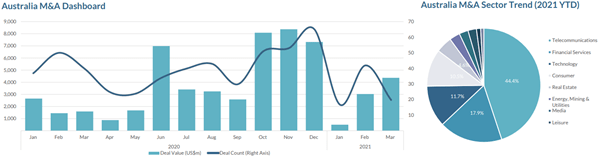
1. Tee, Gerry, Mergermarket, “Australia M&A Dashboard” (15 March 2021)

29.5.2026

Sector dashboards May 2026

Our monthly sector dashboards are out! Our dashboards look at the valuation multiples across seven key sectors, each made up of a number of subsectors. The data takes into account the sale prices of similar companies based on; products, end markets, services, assets classes or other characteristics. The publications include all companies listed on the […]

Read more
28.5.2026

InterFinancial advises Commit Works on sale to Datamine

Commit Works is a Brisbane-based software company serving the mining and metals industry. Its CiteOps platform digitises shift-level planning, resource allocation, task coordination and production tracking, connecting the short-term plan to what actually happens on shift across underground coal, open cut, underground hardrock and smelter operations globally. Datamine is the world’s leading provider of technology […]

Read more
29.4.2026

Sector dashboards April 2026

Our monthly sector dashboards are out! Our dashboards look at the valuation multiples across seven key sectors, each made up of a number of subsectors. The data takes into account the sale prices of similar companies based on; products, end markets, services, assets classes or other characteristics. The publications include all companies listed on the […]

Read more
29.4.2026

From technical capability to economic inevitability: Why Clean Energy companies fail to scale?

Working with organisations attempting to commercialise clean energy technologies, I have observed a pattern persistent enough to warrant explicit articulation. Across hydrogen, electrification, storage, biogas, low-carbon fuels, and industrial heat, companies with credible technology, capable teams, and supportive boards still fail to compound enterprise value. Not because the technology disappoints, and not because the market […]

Read more
31.3.2026

Sector dashboards March 2026

Our monthly sector dashboards are out! Our dashboards look at the valuation multiples across seven key sectors, each made up of a number of subsectors. The data takes into account the sale prices of similar companies based on; products, end markets, services, assets classes or other characteristics. The publications include all companies listed on the […]

Read more
31.3.2026

Not every healthcare deal is a sale: rethinking what M&A can look like

When healthcare business owners come to us thinking about a transaction, the conversation almost always starts in the same place. What is the business worth, and what does a sale process look like? Those are the right questions. But they’re not always the only ones that matter. Embedded in both is an assumption; that the […]

Read more
27.2.2026

Sector dashboards February 2026

Our monthly sector dashboards are out! Our dashboards look at the valuation multiples across seven key sectors, each made up of a number of subsectors. The data takes into account the sale prices of similar companies based on; products, end markets, services, assets classes or other characteristics. The publications include all companies listed on the […]

Read more
27.2.2026

On the floor at EvokeAg 2026: Luke Harwood’s reflections on Australian Agtech

EvokeAg 2026 drew over 1,500 delegates from 18 countries to Melbourne in February, with the Federal Government committing another $450,000 to support the event over the next three years. The visible momentum is real, and the cohort of companies I spent two days meeting reflected it. Most were past proof-of-concept by a meaningful margin, with […]

Read more