


Australia’s new merger control regime: What you need to know by 2026

30.9.2025

Australia is heading into a new phase in how mergers and acquisitions are regulated. From 1 January 2026, a new mandatory merger control regime kicks in. That means if your deal crosses certain thresholds, you’ll need ACCC approval before completing.  

There’s a transitional period from 1 July 2025, where businesses can start using the new system voluntarily, giving dealmakers a chance to test the waters early.  

So, what’s actually changing and what does it mean for you?  

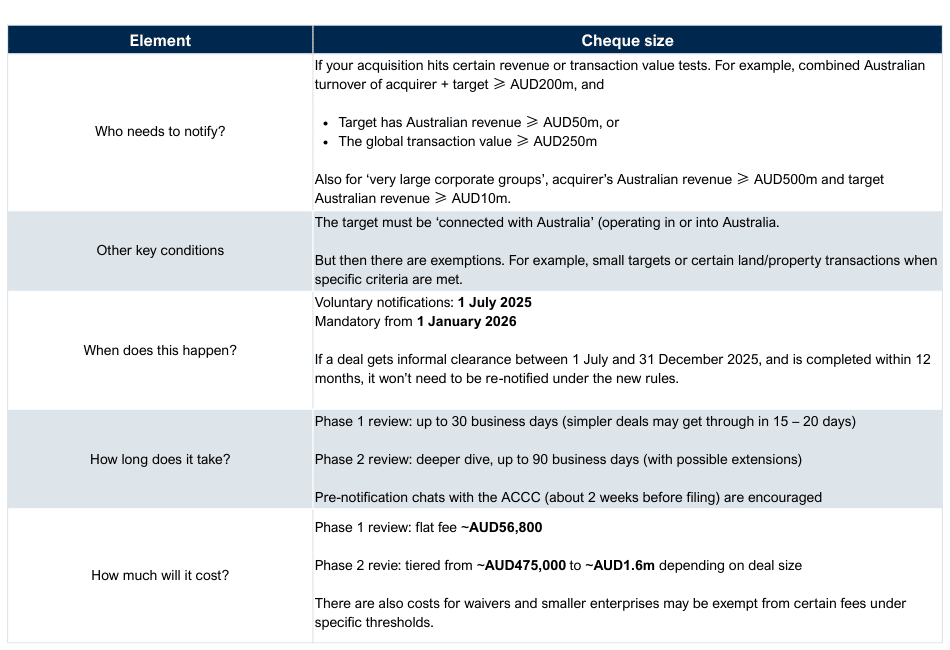
Regulation summary

Here are the key elements of the new regime, including thresholds, timing and costs:
What we’re already seeing in the market?

Even before the rules are mandatory, dealmakers are already adjusting:  

  • Contracts and discussions now factor in regulatory deadlines.  
  • Some deals are being pushed to wrap before 1 January 2026. 
  • Businesses are seeking clarity from the ACCC with questions (e.g. how cumulative acquisitions are counted, how ‘control’ is defined). 
  • A few parties are voluntarily notifying early to see how their deal stacks up.  

In short: no one wants surprises. 

What does it mean once the regime is live?

Here’s what dealmakers should expect from 2026 onwards: 

  • More rigorous planning: Expect to pull together detailed data (market shares, revenues, overlaps).  
  • Longer timelines: Some deals may need months for review. 
  • Higher costs: Filing fees + legal and economic advice add up quickly.  
  • Deal structure tweaks: Parties may consider alternative structures to avoid thresholds. 
  • Some slowdown: Deals close to thresholds or in concentrated industries may face delays.  
  • Clarity over time: Once the ACCC starts publishing decisions, we’ll all have a clearer picture. Until then, expect some uncertainty.   

What should you do now?

  • Audit your pipeline: Test current and upcoming deals against the new thresholds. 
  • Get in early: If possible, seek informal clearance or voluntary notification from mid-2025.  
  • Plan for time: Build review periods into deal timelines.  
  • Budget properly: Factor in regulatory and advisory fees.  
  • Stay informed: Watch for ACCC and Treasury guidance as the first wave of cases comes through.  

Bottom line

The new ACCC merger control changes are real. Dealmakers are already adjusting timelines and strategies, and once January 2026 hits, regulatory planning won’t be optional. It’ll be front and centre of every transaction.  

The good news? While the first year may bring some uncertainty, over time we’ll have more clarity on thresholds, costs and timelines. For now, the smartest move is to plan ahead, stay informed and factor in regulatory approval into your deal strategy.  

If you want to further understand how these changes could affect your business or upcoming deals? Reach out to Executive Director, Brad Shaw, who’d be happy to chat through the details and what they might mean for you.  

Source: ACCC Merger control regime

  

29.5.2026

Sector dashboards May 2026

Our monthly sector dashboards are out! Our dashboards look at the valuation multiples across seven key sectors, each made up of a number of subsectors. The data takes into account the sale prices of similar companies based on; products, end markets, services, assets classes or other characteristics. The publications include all companies listed on the […]

Read more
28.5.2026

InterFinancial advises Commit Works on sale to Datamine

Commit Works is a Brisbane-based software company serving the mining and metals industry. Its CiteOps platform digitises shift-level planning, resource allocation, task coordination and production tracking, connecting the short-term plan to what actually happens on shift across underground coal, open cut, underground hardrock and smelter operations globally. Datamine is the world’s leading provider of technology […]

Read more
29.4.2026

Sector dashboards April 2026

Our monthly sector dashboards are out! Our dashboards look at the valuation multiples across seven key sectors, each made up of a number of subsectors. The data takes into account the sale prices of similar companies based on; products, end markets, services, assets classes or other characteristics. The publications include all companies listed on the […]

Read more
29.4.2026

From technical capability to economic inevitability: Why Clean Energy companies fail to scale?

Working with organisations attempting to commercialise clean energy technologies, I have observed a pattern persistent enough to warrant explicit articulation. Across hydrogen, electrification, storage, biogas, low-carbon fuels, and industrial heat, companies with credible technology, capable teams, and supportive boards still fail to compound enterprise value. Not because the technology disappoints, and not because the market […]

Read more
31.3.2026

Sector dashboards March 2026

Our monthly sector dashboards are out! Our dashboards look at the valuation multiples across seven key sectors, each made up of a number of subsectors. The data takes into account the sale prices of similar companies based on; products, end markets, services, assets classes or other characteristics. The publications include all companies listed on the […]

Read more
31.3.2026

Not every healthcare deal is a sale: rethinking what M&A can look like

When healthcare business owners come to us thinking about a transaction, the conversation almost always starts in the same place. What is the business worth, and what does a sale process look like? Those are the right questions. But they’re not always the only ones that matter. Embedded in both is an assumption; that the […]

Read more
27.2.2026

Sector dashboards February 2026

Our monthly sector dashboards are out! Our dashboards look at the valuation multiples across seven key sectors, each made up of a number of subsectors. The data takes into account the sale prices of similar companies based on; products, end markets, services, assets classes or other characteristics. The publications include all companies listed on the […]

Read more
27.2.2026

On the floor at EvokeAg 2026: Luke Harwood’s reflections on Australian Agtech

EvokeAg 2026 drew over 1,500 delegates from 18 countries to Melbourne in February, with the Federal Government committing another $450,000 to support the event over the next three years. The visible momentum is real, and the cohort of companies I spent two days meeting reflected it. Most were past proof-of-concept by a meaningful margin, with […]

Read more